
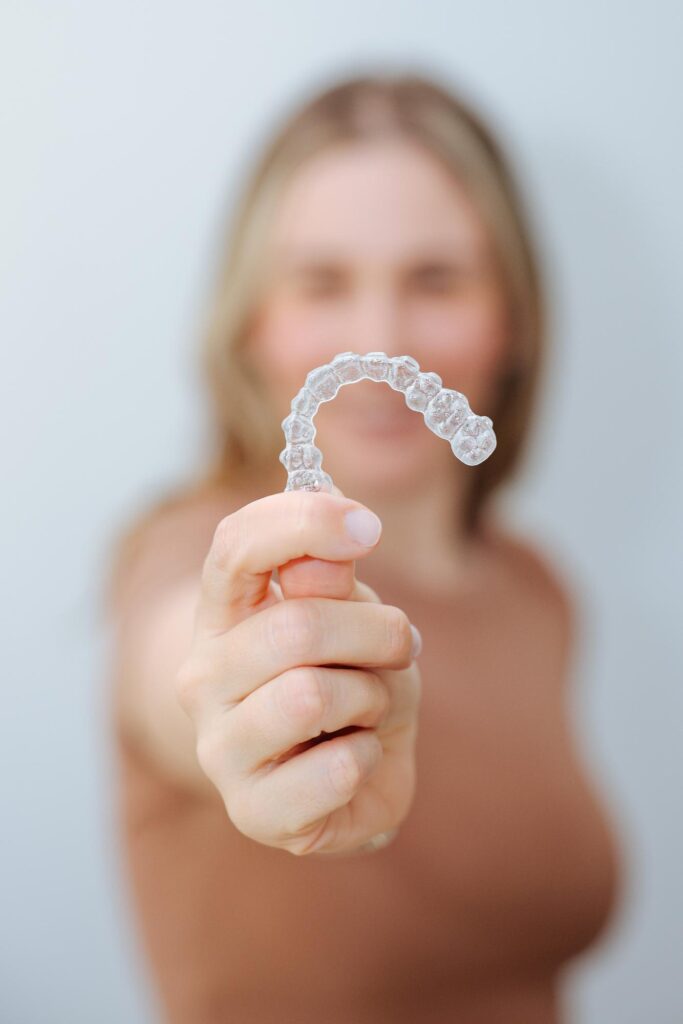
When you’re weighing braces against Invisalign, the decision comes down to understanding two proven options. Braces use metal brackets bonded to your teeth, connected by archwires that gently shift teeth into position. Invisalign, often called clear aligners, is a series of transparent, removable trays custom-made to move your teeth in stages.
Both treatments at Sunflower Orthodontics correct the same kinds of issues:
- Crowded or overlapping teeth
- Gaps and spacing concerns
- Overbites, underbites, crossbites, and other forms of malocclusion
- Crooked or rotated teeth
What’s the biggest day-to-day difference? Braces stay on your teeth around the clock. Clear aligners come out for meals, brushing, and special occasions. We offer braces for all ages and clear aligners for patients of all ages, including children, teens, and adults. A meaningful share of the patients we see are adults, so you’re in good company no matter your stage of life. Many people are surprised to learn just how many grown-ups choose to straighten their teeth later in life.
How Each Treatment Works
Braces and clear aligners both move teeth by applying steady, gentle pressure over time, but they do it differently. Braces use fixed brackets and wires to guide teeth into place around the clock. Clear aligners use a series of removable trays, each one nudging your teeth a little closer to their final position.
Both treatments start the same way, with a free consultation with Dr. Jae, digital scans of your teeth, and a custom plan designed just for you. From there, the day-to-day experience looks a little different.
Brackets are bonded to each tooth and connected by a thin archwire. The wire applies steady, gentle pressure that guides teeth into their new positions. You’ll visit our practice every 4 to 8 weeks so Dr. Jae can make adjustments and track progress. Modern options like KLOwen self-ligating braces use a built-in clip instead of elastic ties, which means smoother movement and fewer visits for many patients. That built-in clip also makes cleaning a little easier between visits.
Clear aligners (Invisalign-style treatment)
You’ll wear each set of aligners 20 to 22 hours a day, removing them only to eat, drink anything other than water, and brush. Most patients switch to a new tray every 1 to 2 weeks. Checkups happen every 6 to 10 weeks so we can confirm everything is tracking as planned. SureSmile technology helps us map out each stage with precise planning, so every tray has a clear purpose.
Average treatment time for either option typically falls between 12 and 24 months, depending on the complexity of your case.
Benefits of Braces and Invisalign
Each option has real strengths. The best fit depends on your case, your lifestyle, and your goals.
Why patients choose braces:
- Excellent for complex bites, significant crowding, and rotated teeth
- Work 24/7 without relying on patient compliance
- Often a great choice for younger kids and active teens
- KLOwen self-ligating brackets can reduce friction and shorten visits
Why patients choose clear aligners:
- Nearly invisible, so most people won’t notice them
- Removable for meals, brushing, and flossing
- No food restrictions, take them out and eat what you love
- Smooth plastic feels comfortable against cheeks and gums
- Often fewer in-office visits over the course of treatment
Both deliver lasting, healthy results when worn as Dr. Jae recommends. According to the American Association of Orthodontists, straight teeth are easier to clean and less prone to wear, decay, and gum issues, so either option supports long-term oral health, not just appearance. That long-term payoff is one reason so many patients tell us they wish they’d started sooner.
Braces vs Invisalign: Side-by-Side Comparison
Want it laid out side by side? Here you go.
| Feature | Braces | Clear Aligners |
|---|---|---|
| Appearance | Visible (metal) | Nearly invisible |
| Comfort | Brackets may cause occasional irritation | Smooth plastic, generally comfortable |
| Removable? | No, fixed to teeth | Yes, remove to eat and brush |
| Diet | Avoid sticky, hard, and crunchy foods | No food restrictions |
| Oral hygiene | Requires extra care around brackets | Brush and floss normally |
| Office visits | Every 4-8 weeks | Every 6-10 weeks |
| Best for | Complex bites, severe crowding, kids | Mild to moderate cases, disciplined wearers |
| Compliance | Always working | Requires 20-22 hours/day wear |
| Treatment time | 12-24 months (typical) | 12-24 months (typical) |
A few honest notes:
- Braces are often the stronger choice when teeth need significant rotation or vertical movement.
- Clear aligners are a standout when you want a discreet option and you’re willing to commit to wearing them consistently.
- For some patients, a combination approach works best, and Dr. Jae will let you know if that’s the case.
Which Treatment Is Right for You?
Choosing between braces and clear aligners is a personal decision, and there’s no single right answer. Dr. Jae will help you weigh the clinical factors with what fits your life.
Clear aligners may be the better fit if you:
- Have mild to moderate crowding, spacing, or bite concerns
- Can commit to wearing them 20-22 hours a day
- Want a discreet option for work, school, or social settings
- Prefer being able to remove your appliance for meals and photos
Braces may be the better fit if you:
- Have complex bite issues, severe crowding, or significant rotations
- Are a younger child still developing adult teeth
- Don’t want to think about compliance, since they’re always working
- Want the most predictable option for difficult tooth movements
Teens and adults often gravitate toward clear aligners for the discretion, while kids and tweens frequently do best in braces. If your child is younger than that, the first question is timing rather than treatment type, and we walk through when to schedule a first orthodontic visit separately. How can you know for sure which one suits you? An evaluation with a board-certified orthodontist who can look at your teeth, bite, and goals together gives you the clearest answer.
Frequently Asked Questions
Is Invisalign as effective as braces?
For mild to moderate cases, clear aligners can be just as effective as braces when worn 20-22 hours a day as directed. For more complex bites or severe crowding, traditional braces are often the more predictable choice. Dr. Jae will review your specific case during your free consultation and recommend the option that delivers the best result for your teeth.
How long does each treatment take?
Most patients complete treatment in 12 to 24 months, whether they choose braces or clear aligners. Simple cases sometimes finish in under a year, while more involved corrections can take longer. Your treatment time depends on your starting point, the movements required, and, for aligners, how consistently you wear your trays.
Can teens use Invisalign?
Yes. Many teens are excellent candidates for clear aligners, especially those who play instruments, are involved in contact sports, or simply prefer a discreet look. The key is consistent wear. If a teen is reliable about keeping their aligners in, results can be excellent and right on schedule.
Does treatment hurt?
You may feel mild pressure or tenderness for a day or two after braces are adjusted or when you switch to a new aligner. That’s the sensation of your teeth moving, and it fades quickly. Most patients describe it as a dull soreness, not anything sharp. Over-the-counter relief and soft foods help during those first few days.
You don’t have to figure this out on your own. Dr. Jae Brimhall is a board-certified orthodontist, and we’re your neighbors and friends here in Mansfield. We’d love to help you discover the smile of your dreams. Schedule your free consultation today and let’s talk through your options together, with no rush and no pressure.